Scientist to founder
A conversation on the journey from theoretical science to industry, with the co-founder and Chief Scientist of GreenCat.

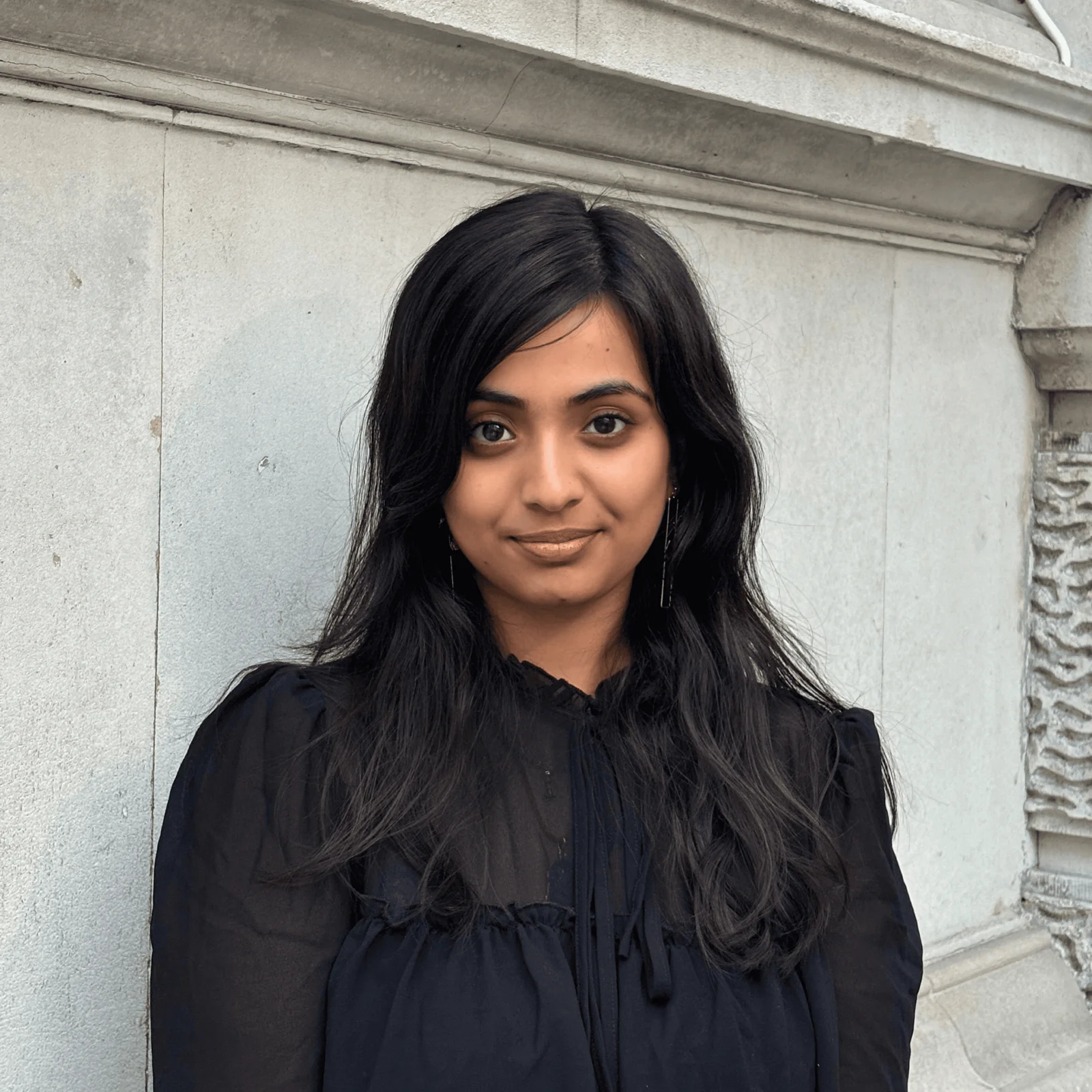
Dr Shambhawi Pandey, Chief Scientist and Co-Founder of GreenCat, sits down with Pamir Ventures to discuss her journey from scientist to founder, and how her PhD research evolved into a commercially viable platform reshaping catalyst discovery.
For readers new to GreenCat, can you tell us a bit about your background and what your company does?
I am a scientist by trade, completing my Chemical Engineering PhD in 2023. I worked with industry very briefly, starting on reaction systems and eventually transitioning into catalysts.
I never liked sitting on the sidelines and always preferred the applicable science with the most real-world impact. During this time, GreenCat was born.
It's a bit of a mouthful, but we are a catalyst discovery and optimisation platform. We use a complex set of physics and mathematics driven algorithms to digitally discover new catalyst formulations in a fraction of the time compared to traditional methods. The implications are broad and far reaching and we are the first platform (that we know of) that is capable of searching the entire periodic table for solutions in this way.
What problem did you see that wasn't being properly addressed and why did it feel urgent enough to build GreenCat around it?
During my Masters, I naively thought it would be easy to find a novel catalytic reaction. How wrong I was! Nine months, immense amounts of compute and three collaborations later I came to the painstaking conclusion that the reaction wasn't even valid. Deeply frustrated, I thought there must be a better process out there. This problem became the foundation for my PhD thesis and then later, GreenCat.
Was there a specific moment when you realised this thesis could move from theory to something commercially viable? Your Eureka moment?
I had countless conversations with colleagues in industry, ranging from AstraZeneca to BASF, they all had the same issue. They complained about the slowness of identifying new catalysts, having to use traditional trial and error methods that took years. Even when innovation did come, it was only an iterative step change.
I was horrified to find out even at the largest chemical firms with millions in R&D, their catalysts had barely changed over the last 100 years. The processes we use today would not look unfamiliar to the scientists that made the original discoveries!
I realised my algorithm, which was in its infancy at this point, could provide the efficiency gains needed to make radical changes commercially viable.
Why is now the right time for GreenCat? What's changed in the market or the world that makes this possible?
It most definitely is the right time. In some ways, I wish GreenCat had been around decades ago, so we could break free from many of these outdated processes.
Yet today the challenges our planet faces mean we have urgency for efficiency gains. Our demand for many essential chemicals is rising rapidly, but we must increasingly offset their associated emissions.
I know GreenCat can harmonise this dissonance. We must challenge orthodoxy and find new processes that both increase yield while decreasing carbon footprint.
You began your career as a scientist. How did you navigate the transition into a Chief Scientist and Co-Founder?
I kind of fell into it. I didn't really start or think to start as a commercial founder. I joined an accelerator program and had great exposure to key mentors who are with me to this day. They loved my idea and gave me a key point of advice: convince someone of my idea and form a team.
At the time, I knew the science, but I didn't know how to network, raise funds, practically apply my idea to industry realities, or lead a team. It was important I found someone who not only resonated with my idea but had complementary skills to mine, who could mentor me, as I learnt the needed skills to lead. I was lucky to meet our CEO, Rohit Pothukuchi, at Cambridge. Together, we formed GreenCat and have not looked back, and I feel to this day, it was the best decision I have ever made.
At first, Rohit handled most of the commercial aspects, team formation, oversight of platform construction, and leadership. But I did not let myself off the hook and retreat into my science. I pushed myself and learnt what it meant to be a leader and co-founder, what it meant to build and run a team etc. Now, we have a team of approximately 25 members, ranging across tech, operations and science.
The transition made me appreciate having a good idea is never enough, you need to find the right team with the right attitude, that's what it means to be a co-founder.
What's fundamentally different about the world of business compared to science?
The biggest difference for me were the timelines. I was raised in the world of academia, where you had a hypothesis and you would find the evidence to prove or disprove over many years.
In business, you don't have that luxury. You're always on the move, having to juggle multiple projects across diverse timelines. In that way, the business world is far more efficient and ruthless even.
What skills did you have to consciously learn and what habits did you have to unlearn along the way?
For me, I think it was the skill of being comfortable with uncertainty. Again, in academia you have an idea, and you research until you prove or disprove it with certainty.
This compared to business, where you must be decisive without the prerequisite time or evidence. You must move quickly, going forward even if you don't have all the necessary information in front of you.
At first, this adjustment was very jarring, and the scientist in me would habitually try to slow processes down until clarity presented itself. I learnt quickly that life as a founder is fundamentally different, where certainty is rare and quick action is required.
Has building a company changed the way you think about science itself? Have you taken anything from the commercial world back into your scientific mindset?
Most definitely! I approach science in a far more customer-centric manner. I think less about the science as an intellectual pursuit but more from the lens of commercial viability. Nowadays, when a reaction is found, I think beyond just what and why and more will this help solve a key industry problem in a practical and economically viable way?
On a personal level, how has your identity shifted since becoming a founder, do you feel more like a scientist or more like a founder?
There have been significant changes. I can't entirely explain it but, I see life from more of a managerial angle. To give you a funny example my husband says I remind him of his manager! Even when doing domestic tasks such as planning for dinner, I can't help assigning tasks based on competency and timelines as I would during work.
In terms of which I am more, founder or scientist, I think I will always be a scientist at heart, and even today, I still wear the science hat occasionally. Nevertheless, I am still most comfortable being a scientist, but really value the skills and perspective given to me during my journey to become a co-founder.
Looking ahead, what are your ambitions for GreenCat over the next year and what would meaningful progress look like?
I have, like all founders, big dreams for the company. GreenCat has a lot in the pipeline, and it is only the beginning. There are billion-dollar markets we can enter and revolutionise. I want to make the modern-day equivalent of Haber-Bosch's discovery!
But, grandstanding aside, we are really focused on delivery and scale-up, wanting to get the basics right, yet our dreams and ambitions remain my guiding light.